

Coimbra Group and the Durham Declaration at COP30: Advancing University-Led Climate Action and Collaborative Research
16 December 2025
The Coimbra Group strengthened its international engagement on climate action at COP30 in Belém, Brazil, through the launch of the Durham Declaration on Climate Change and Sustainability and through Durham University’s convening of high-level discussions on ocean governance, climate law, and climate science. These activities underscored the growing role of universities as key actors in addressing climate change through connecting research, education, and policy engagement, with inter-institutional cooperation at high-level events of global reach.
Launch of the Durham Declaration at COP30
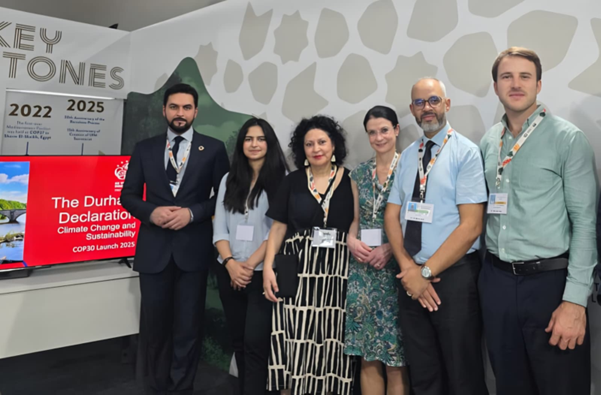
On 12 November 2025, Durham University, acting on behalf of the Coimbra Group, convened and hosted the roundtable discussion “Higher Education as a Climate Catalyst: From Regional Cooperation to Global Scale” at the Union for the Mediterranean Pavilion during COP30. The in-person event brought together universities and university alliances from across the globe to explore how regional higher education initiatives can be better aligned and connected into a global climate action ecosystem capable of delivering impact at scale.
A central highlight of the discussion was the formal launch of the Durham Declaration on Climate Change and Sustainability, presented by Professor Petra Minnerop (Durham University). The Declaration, adopted earlier in 2025 at the Coimbra Group Climate Symposium and signed by the Rectors of all Coimbra Group member universities, articulates a shared commitment to embedding sustainability and climate responsibility across all dimensions of academic life, including governance, education, research, innovation, and institutional operations. Participants recognised the Declaration as a concrete roadmap for university-led climate action.
The discussions also addressed the emerging Euro-Mediterranean University Initiative for Climate Action, inspired by the Girona Manifesto, which mobilises universities across the Mediterranean region to collaborate on climate education, research, innovation, student engagement, and climate governance. Durham University also showcased progress on its ongoing British Academy funded research project ELEVATE ProClima – Enhance and Leverage the Architecture on Evidence for Proteção Climática (Climate Protection), illustrating how academic research can inform climate policymaking.
Key messages from the discussion included:
- Recognition of universities as drivers of climate resilience and societal transformation
- Positioning the Durham Declaration and its Seven Principles as a guiding framework for higher education
- Exploration of regional coordination models (Euro-Mediterranean, African Union, ASEAN, Latin America, among others)
- Envisioning a shared global roadmap to scale climate action across higher education
The roundtable concluded with a call to action to build a global coalition of regional university initiatives on climate, laying the groundwork for coordinated engagement at SB64, COP31, and beyond, including preparations for a dedicated higher education event at COP31.
Ocean Governance and Climate Action at the Ocean Pavilion
In addition to the Durham Declaration launch, Durham University convened and hosted a second major event at COP30 at the Ocean Pavilion, titled “New Research Frontiers in Law and Science: From the Deep Sea to Rising Sea Levels.” This interdisciplinary event highlighted the critical intersections between ocean governance, climate science, and international law.
The panel brought together leading experts from law, science and policy-making, including Dr Filipa Bessa, a marine biologist from the University of Coimbra whose research focuses on deep-sea ecosystems, marine biodiversity, and the impacts of climate change and human activities on ocean health. She was joined by Pam Pearson (Director of the International Cryosphere Climate Initiative, climate science and policy), Professor Elisa Morgera, UN Special Rapporteur on Human Rights and Climate Change (Durham University, international law, human rights, and climate governance), and Ana Paula De Souza (Human Rights Officer at the OHCHR, climate justice and civil society engagement). Concluding remarks were provided by U.S. Senator Sheldon Whitehouse (Rhode Island).
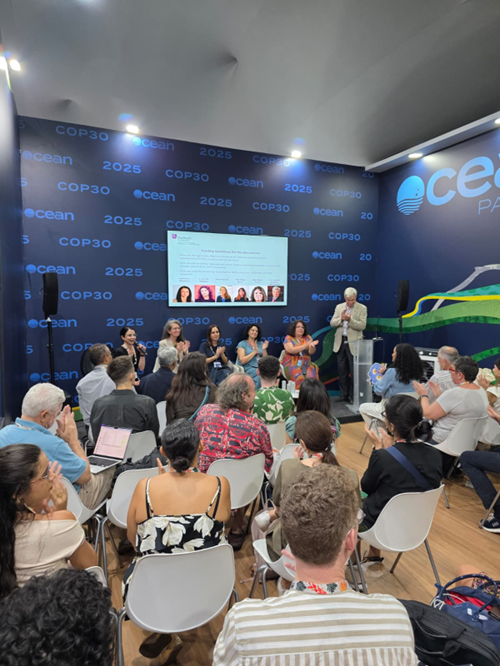
The discussion was chaired by Professor Petra Minnerop (Durham University) and structured around three guiding questions:
- How stringent due diligence standards for Nationally Determined Contributions (NDCs) can be defined and operationalised from both legal and scientific perspectives
- How “appropriate action” to protect the climate system from greenhouse gas emissions should be defined based on scientific evidence
- How new thresholds for greenhouse gas emissions can be identified and applied
Key takeaways underscored that sufficient scientific evidence already exists—particularly from the IPCC—to define economy-wide NDC targets aligned with the 1.5°C temperature goal of the Paris Agreement. Panellists emphasised that there is a single long-term temperature goal and that even achieving it will entail significant sea-level rise over coming centuries, with profound implications for coastal communities and the very existence of some States.
The discussion highlighted the need for strengthened international cooperation to support countries with limited capacity to integrate science into their NDCs, improved data on the health impacts of extreme weather events, and the adoption of holistic, human-rights-based approaches to climate action. The regulation of the fossil fuel industry through clear, legally defined transition targets was identified as essential.
A key outcome of the event was the recognition that marine biologists, climate scientists, and international lawyers must work together to define and operationalise stringent due diligence standards under international frameworks, including the UNFCCC (United Nations Framework Convention on Climate Change), UNCLOS (United Nations Convention on the Law of the Sea), and the Paris Agreement.
Strengthening the Coimbra Group’s Global Climate Engagement
Through these COP30 contributions, the Coimbra Group and its member universities reaffirmed their commitment to advancing climate action through interdisciplinary research, education, international collaboration, and sustained policy engagement. The launch of the Durham Declaration and the active participation of Coimbra Group scholars in high-level discussions demonstrate the network’s capacity to contribute meaningfully to global climate governance and to shape the role of higher education in responding to one of the defining challenges of our time.