

Coimbra Group calls the EU to address barriers to global talent
12 December 2025
The Coimbra Group actively contributed to the European Commission’s Implementation Dialogue on Talent Attraction and Retention, hosted by Commissioner Magnus Brunner in Brussels on 11 December.
Represented by its Brussels Office Director, Emmanuelle Gardan, the network called for a holistic approach to make Europe a more attractive destination for global talent.
During the dialogue, the Coimbra Group outlined systemic barriers faced by universities, including restrictive immigration policies, administrative complexity, uneven implementation of the EU Blue Card Directive, fragmented recognition of foreign qualifications, and limited portability of residence and work permits, as well as social rights, across Member States. The network also underlined contradictions across EU policies and negative narratives around migration that weaken the EU’s attractiveness as a global talent hub.
“International students represent an important untapped talent pool. We need longer post-study work permits for graduates from third countries who complete their studies at EU higher education institutions”, stressed Emmanuelle Gardan.
Emphasising that barriers to attracting and retaining research and innovation talent from third countries in the EU are systemic and closely interlinked, she advocated for a comprehensive, whole-system policy approach integrating legislative, operational, and socio-cultural dimensions.
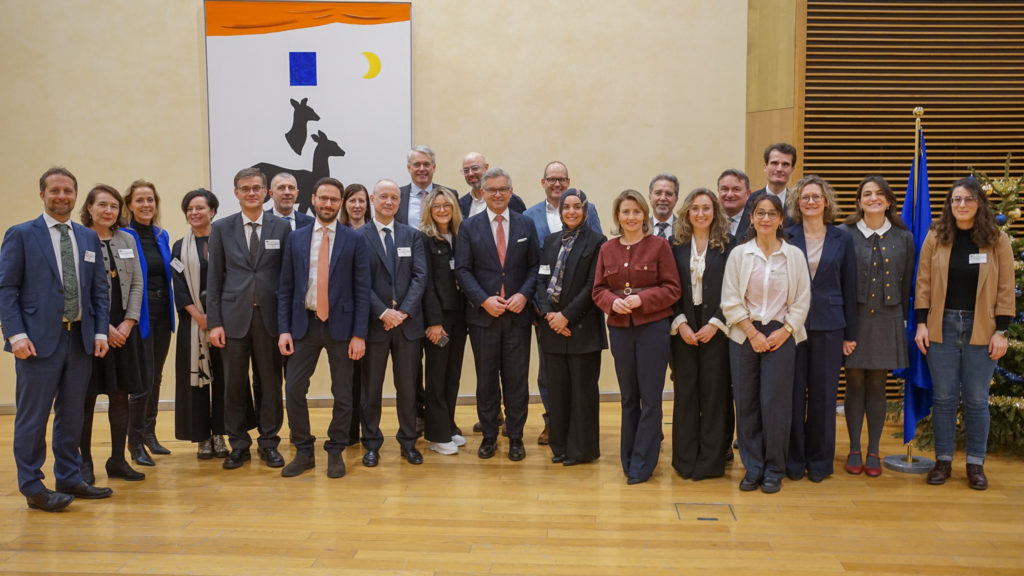
The dialogue brought together 27 leaders from a wide range of public and private organisations to exchange views on challenges, best practices, and possible solutions to improve the implementation and simplification of the EU legal migration acquis and talent retention policies.
Participants shared practical measures to simplify procedures and improve integration, such as the creation of one-stop shops for newcomers, simplified job application procedures for third-country nationals, targeted information campaigns abroad, cooperation and mobility agreements with non-EU partners, and the use of digital matching tools to connect employers with skilled workers. Consensus emerged on the need for faster, simpler administrative procedures and stronger integration support.
Commissioner Brunner reaffirmed the EU’s ambition to attract talent as part of the Union of Skills (2025) and linked it to recent EU initiatives like the EU Startup and Scaleup Strategy and Choose Europe (2025). He announced a new EU Visa Strategy for January 2026, that will focus on concrete measures to simplify and accelerate procedures to attract and retain top talents for innovation. The Commission will also adopt in 2026 the Fair Mobility Package, which will include the possible revision of the European Labour Authority and the Skills Portability Initiative, aimed at improving the recognition of qualifications and validation of skills of third-country nationals.
Commissioner Brunner encouraged continued engagement to inform future EU initiatives on skills, mobility, and legal migration. The Coimbra Group remains committed to providing research- and evidence-based input to the European Commission to support effective talent attraction and retention policies across the European Union.